News
Every October a tree from another continent takes over the skyline of a city it was never meant for. The history of jacaranda trees in Nairobi is, in the end, a story about how a place decides what belongs to it. Jacaranda mimosifolia evolved in the dry subtropical valleys of South America, travelled the world in the pockets of botanists and the plans of town planners, and arrived in a railway settlement on the Athi plains at the start of the twentieth century. A hundred and some years later, Nairobians speak of "our jacarandas" without a trace of irony, and visitors who stay in the green quarters of the city, in suburbs such as Karen around Karen Plains Hotel, come home with a purple-tinted memory of the place.
A South American tree in an East African town
Jacaranda mimosifolia is native to a band of South America that takes in parts of Argentina, Bolivia and Brazil. It is a fast-growing, deep-rooted tree with fine, fern-like leaves, and in the right climate it drops those leaves briefly before flowering, which is why the colour appears so suddenly and so completely. European botanic gardens were cultivating it by the nineteenth century, and from there it spread through the colonial world to anywhere with warm days, cool nights and a defined dry season. Pretoria, Lisbon, Sydney, Harare and Nairobi all share the same violet inheritance.
Nairobi suited it unusually well. At around 1,700 metres the city is warm without being hot, the air is dry for much of the year, and the arrival of the short rains in October gives the tree exactly the cue it needs to flower. The soils of the older suburbs, deep red and well drained, let the roots go down. What was an ornamental experiment became, within a few decades, a thriving population.
The history of jacaranda trees in Nairobi: from railway camp to garden city
Nairobi began in 1899 as a depot for the Uganda Railway, a flat and swampy site chosen for logistics rather than beauty. As the settlement grew into the administrative capital of the colony, its planners and residents set about making it look like somewhere people might want to live. Trees were central to that effort. From the early 1900s, jacarandas were planted along avenues, around government buildings and in the gardens of the new residential districts, together with other imported ornamentals such as bougainvillea and the Nandi flame.
The precise ledger of who planted what, and when, is not something we would pretend to know. The broad shape of the story is clear enough. The trees went in during the colonial period, grew through the decades of the twentieth century, and by the time Kenya became independent in 1963 the oldest of them were already mature. The neighbourhoods that were most heavily planted then, State House Road and the Arboretum, Muthaiga, Lavington, Kilimani, Upper Hill and the farm-plot suburb of Karen, remain the best places to see the bloom today.
The Nairobi Arboretum itself, established in the early colonial years as a trial ground for trees, is an open-air record of that experiment. Walking its paths in October you see jacarandas standing among species from across the world, each one a decision made a century ago that still shapes the city's light and shade.
Read the city's history under its own trees. Karen Plains Hotel offers clean ensuite rooms, fast Wi-Fi, free secure parking, 24/7 reception and easy access to Karen's malls, restaurants, safari routes and major attractions. Book directly for the smoothest experience, room requests, airport transfer support and quick WhatsApp assistance.
How a borrowed tree became a Nairobi identity
Cities adopt symbols slowly, and often without noticing. Nairobi's jacarandas worked their way into the city's self-image through repetition. Generations of schoolchildren walked to class under them. Office workers in Upper Hill looked out of their windows each October at a sea of purple. Wedding photographers learned the dates. The flowers started to appear in paintings sold at the Maasai Market, on postcards, in the names of estates and businesses, in songs and in the vocabulary of ordinary conversation, where "jacaranda time" means the weeks before the rains.
There is a tension in that story, and it is worth holding onto. Jacaranda is an exotic species, and in some countries it is treated as invasive. In Kenya it is mostly an urban tree, and the conservation conversation, which sharpened with the renaming of 10 October as Mazingira Day and the national push to grow billions of trees, tends to emphasise indigenous species for new planting. The jacarandas that already stand are cherished, photographed and defended. The ones that will be planted in future are more likely to be croton, Nandi flame or fig. That feels about right: a city can love what it inherited and still choose carefully what it leaves behind. Our piece on what Mazingira Day means explores that thread.
Where the oldest and best displays are today
- State House Road. The avenue most associated with the bloom, with the Arboretum alongside. About 40 minutes from Karen by car, traffic depending.
- Nairobi Arboretum. Labelled trees, broad paths, and the chance to see jacarandas in the company of the other imports and natives planted as trials. See our notes on visiting the Arboretum from Karen.
- Muthaiga and Lavington. Old residential districts with tall, mature trees overhanging the roads.
- Upper Hill. The newest skyline against the oldest canopies.
- Karen. Laid out as large farm plots in the early colonial period, Karen kept its trees as it was subdivided. Karen Road, Bogani Road and the roads around Ndege Road are quietly spectacular in late October, and they sit a few minutes from Karen Plains Hotel on Karen Plains Road.
For a street-by-street viewing plan, read our main guide to jacaranda season in Nairobi.
Seeing the story slowly, from a Karen base
History reads better at walking pace. Karen is the part of Nairobi where the layers of that history, the colonial farm plots, the Blixen house, the mature exotic trees and the newer malls and cafés, sit closest together, and it is green enough that the jacarandas feel like a continuation of the landscape rather than an exception to it.
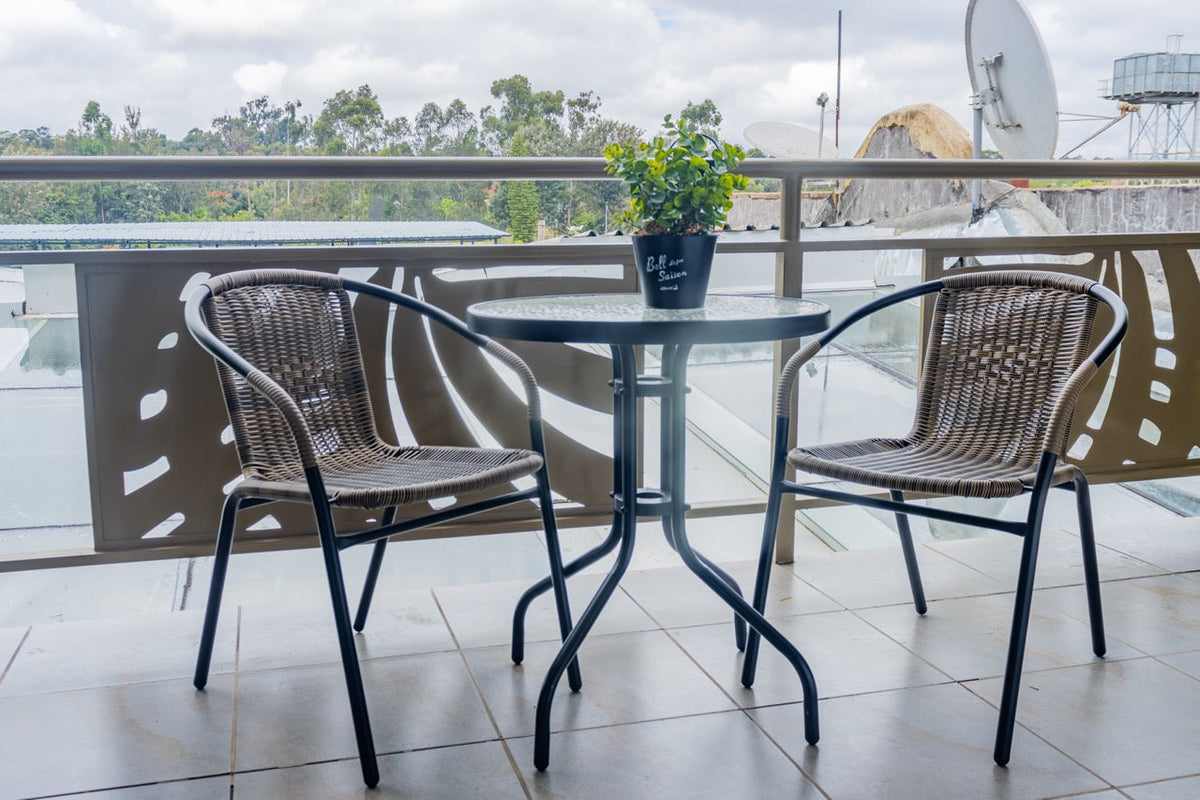
Karen Plains Hotel is a small, calm place to do that from. Rooms are clean and ensuite, with comfortable beds, hot showers, a work desk, fast Wi-Fi and Netflix. Some have a balcony that looks onto trees. There is free secure parking for a self-drive loop of the suburbs, 24/7 reception, breakfast available from 7:00 to 10:30am, laundry on request and a backup generator for the rooms and Wi-Fi. For those who want to stay longer and read, write or simply watch the season turn, a One Bedroom Apartment is available; see our page on long stays in Nairobi. Writers and photographers drawn to the subject may also like our notes for creatives staying in Karen, and anyone planning around the hotel can begin with Plan Your Stay.
FAQ: Nairobi's jacarandas and their history
Are jacaranda trees native to Kenya?
No. Jacaranda mimosifolia is native to South America and was introduced to Nairobi during the colonial period, from the early 1900s, as an ornamental street and garden tree. It has since become one of the city's most recognisable features.
Why were jacarandas planted in Nairobi in the first place?
They were planted to beautify a young railway town as it grew into a capital, along avenues, around institutions and in the gardens of the new suburbs. The climate at Nairobi's altitude suited the tree, and the plantings thrived.
Why do Nairobi's jacarandas flower in October?
The tree flowers at the end of a dry season, as the first rains arrive. In Nairobi that transition happens from mid October into November, which is why the bloom coincides with the start of the short rains.
Is the jacaranda considered invasive in Kenya?
In Kenya it is largely an urban ornamental rather than a problem in natural habitats, though it is treated as invasive in some other countries. Current tree-planting campaigns in Kenya generally favour indigenous species, while the existing jacarandas remain much loved.
Where in Nairobi can I see the oldest jacaranda trees?
The older districts planted in the colonial era hold the most mature trees: State House Road and the Arboretum, Muthaiga, Lavington, Kilimani, Upper Hill and the lanes of Karen. Karen's trees are a few minutes from Karen Plains Hotel.
Stand under a jacaranda on a late October morning in Karen, with the first fallen flowers on the road and the rains not yet arrived, and the century collapses a little. The tree does not know it is foreign. The city has long since stopped caring. That is the whole history, really.
Stay among the trees this October. Book directly with Karen Plains Hotel for your jacaranda-season nights, or message the team on WhatsApp with questions about rooms, the apartment or getting around.